A rental property does not necessarily have to generate significant monthly cash flow to create wealth.
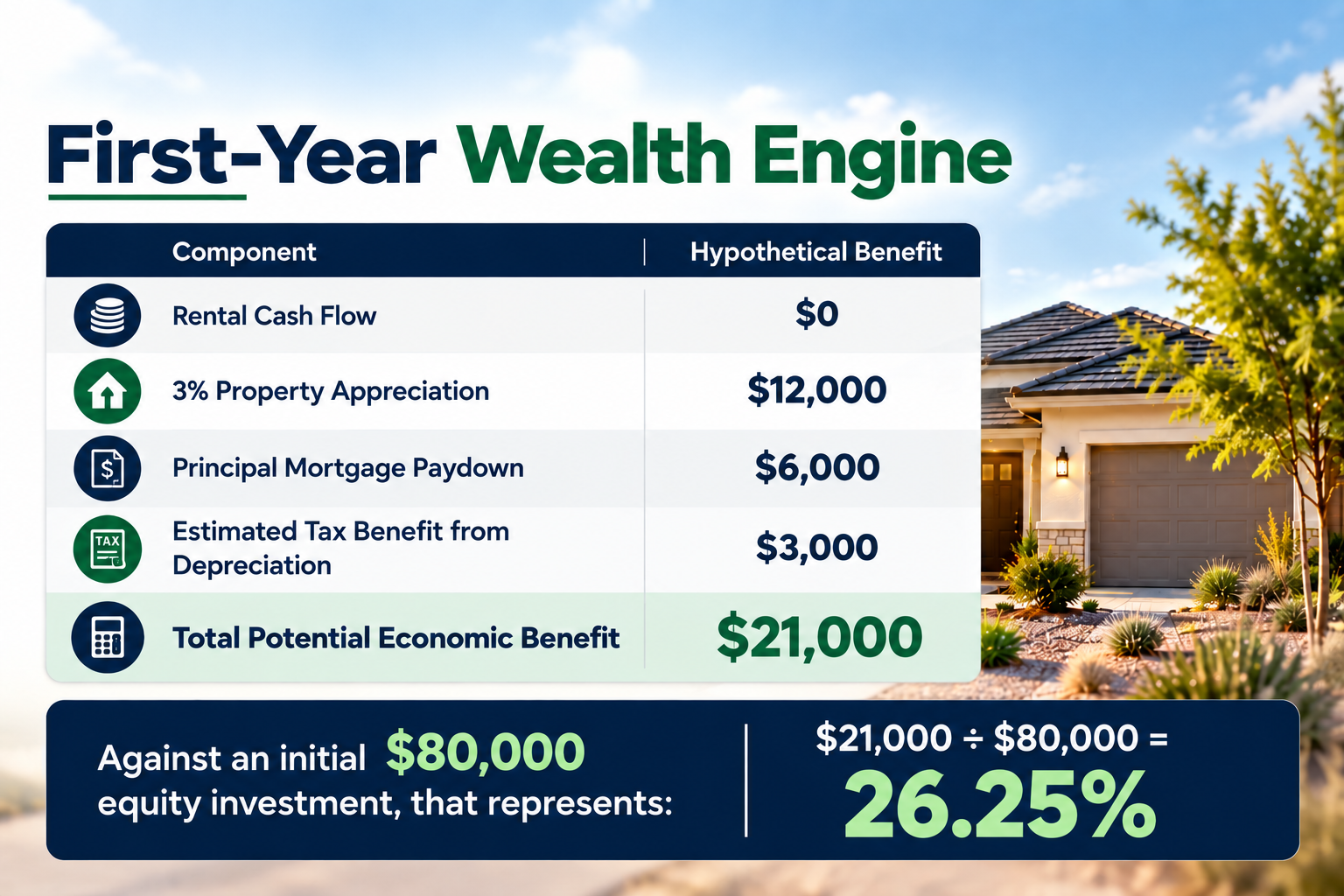
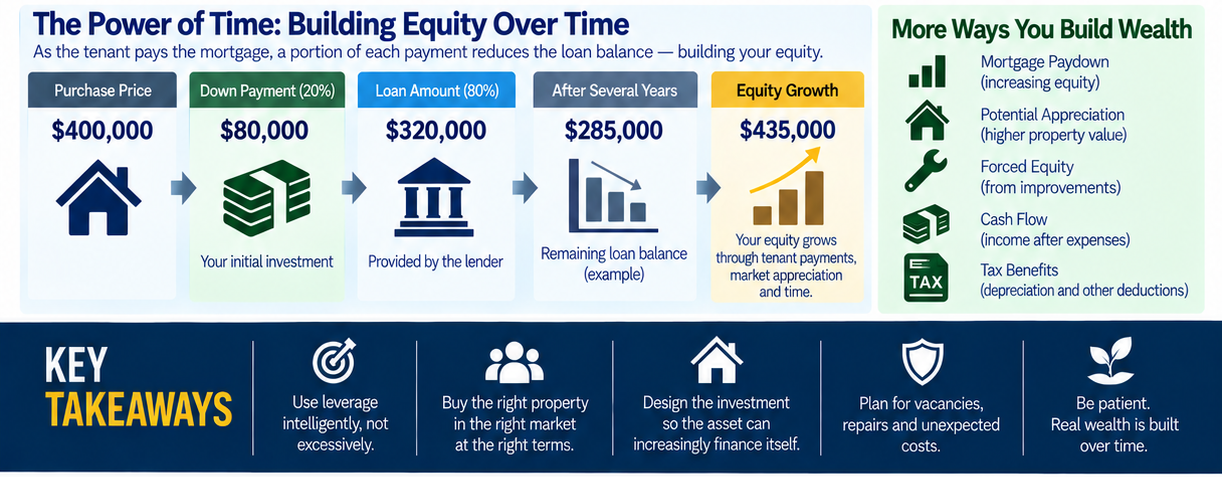
Consider a hypothetical $400,000 rental property purchased with 20% down, requiring an initial equity investment of $80,000. Assume the rent collected during the first year is sufficient to cover the mortgage payments, property taxes, insurance, operating expenses and other modeled property costs. In other words, for purposes of this example, annual rental cash flow is approximately $0.
At first glance, that may sound like a property that produced no return, but cash flow is only one way real estate can make money.
So, under these hypothetical assumptions, a property that merely breaks even from a cash-flow perspective could potentially create more than a 25% first-year economic return on the investor’s original equity.
The Power of Leverage
The important concept is leverage. The investor contributed $80,000, but the entire $400,000 property participates in appreciation. A 3% increase in the property’s value therefore represents $12,000, not 3% of the investor’s $80,000 down payment. That $12,000 alone represents 15% of the original $80,000 investment. Meanwhile, the tenant’s rent helps service the mortgage, a portion of the mortgage payment reduces principal, and depreciation may create an additional income-tax benefit.
This is one reason real estate returns should not be evaluated solely by asking: “How much cash did this property put in my pocket this month?” The better question is: “How much total economic value did this property create relative to the capital I invested?”
This Is Not a 26.25% Cash Return
The hypothetical $21,000 consists of different forms of economic benefit. Appreciation is unrealized equity unless the property is sold or the equity is otherwise accessed. Principal paydown increases ownership equity but is not immediately spendable cash. Depreciation is a tax deduction, and its actual economic benefit depends on the investor’s tax circumstances, depreciable basis, applicable tax rules, passive-activity limitations and other factors. Accordingly, this example should be viewed as a simplified illustration of potential first-year return on equity, not a guaranteed investment return or a 26.25% cash-on-cash return.
Leverage works in both directions. Property values can decline rather than appreciate. A property purchased for $400,000 that falls 5% in value has lost $20,000 of market value—equal to 25% of an $80,000 initial equity investment before considering transaction costs.
A break-even property also provides very little operating cushion. Vacancy, repairs, capital expenditures, insurance increases, property-tax increases, HOA expenses, management costs or unexpected maintenance can quickly turn $0 cash flow negative.
Appreciation is never guaranteed. Principal reduction depends on the actual loan amount, interest rate and amortization schedule. Depreciation calculations generally require separating depreciable building basis from non-depreciable land, and the tax benefit depends on the investor’s individual circumstances. A future sale can also create tax consequences, including potential depreciation recapture.

Leverage works in both directions. Property values can decline rather than appreciate. A property purchased for $400,000 that falls 5% in value has lost $20,000 of market value—equal to 25% of an $80,000 initial equity investment before considering transaction costs.
A break-even property also provides very little operating cushion. Vacancy, repairs, capital expenditures, insurance increases, property-tax increases, HOA expenses, management costs or unexpected maintenance can quickly turn $0 cash flow negative.
Appreciation is never guaranteed. Principal reduction depends on the actual loan amount, interest rate and amortization schedule. Depreciation calculations generally require separating depreciable building basis from non-depreciable land, and the tax benefit depends on the investor’s individual circumstances. A future sale can also create tax consequences, including potential depreciation recapture.
In this hypothetical example, an $80,000 investment potentially produces approximately $21,000 of first-year economic benefit, or 26.25% of the investor’s initial equity, even though the rental itself operates at approximately cash-flow break-even.
That is not a promise of a 25% return. It is an illustration of why sophisticated real estate investors look beyond rent checks and evaluate the entire economic engine of the property.
This example is hypothetical and provided for educational purposes only. Property values and rents can rise or fall, operating expenses can vary materially, financing terms affect principal reduction, and tax treatment depends on individual circumstances and applicable law. The example does not include all acquisition, financing, operating, disposition or tax costs and is not a projection or guarantee of investment performance. Consult appropriate financial, tax and real estate professionals when evaluating an actual investment.