Financial freedom is not simply having more money. It is reaching the point where your assets, income, and financial structure give you meaningful control over how you spend your time and make your decisions. Financial freedom is often portrayed as a destination reserved for people with enormous portfolios, luxury homes, and millions of dollars in the bank, but that definition is misleading.
Financial freedom is fundamentally about having enough financial strength and recurring economic support that money no longer controls every major decision you make.
For one person, that might mean leaving a job they dislike. For another, it could mean working fewer hours, retiring earlier, spending more time with family, starting a business, or simply knowing that an unexpected expense will not destabilize their life. Real estate can be one tool for getting there, but only when the properties you own ultimately serve the life you are trying to build.
What Is Financial Freedom?
Financial freedom is the condition in which your assets, income, savings, and financial obligations give you sufficient control over your time and choices such that earning the next paycheck is no longer the dominant constraint on your life. It does not necessarily mean:
Instead, financial freedom is about creating enough income, equity, liquidity, resilience, and optionality that you can make important life decisions from a position of financial strength.
Financial Freedom Is Personal: Control, Cost, and Choice
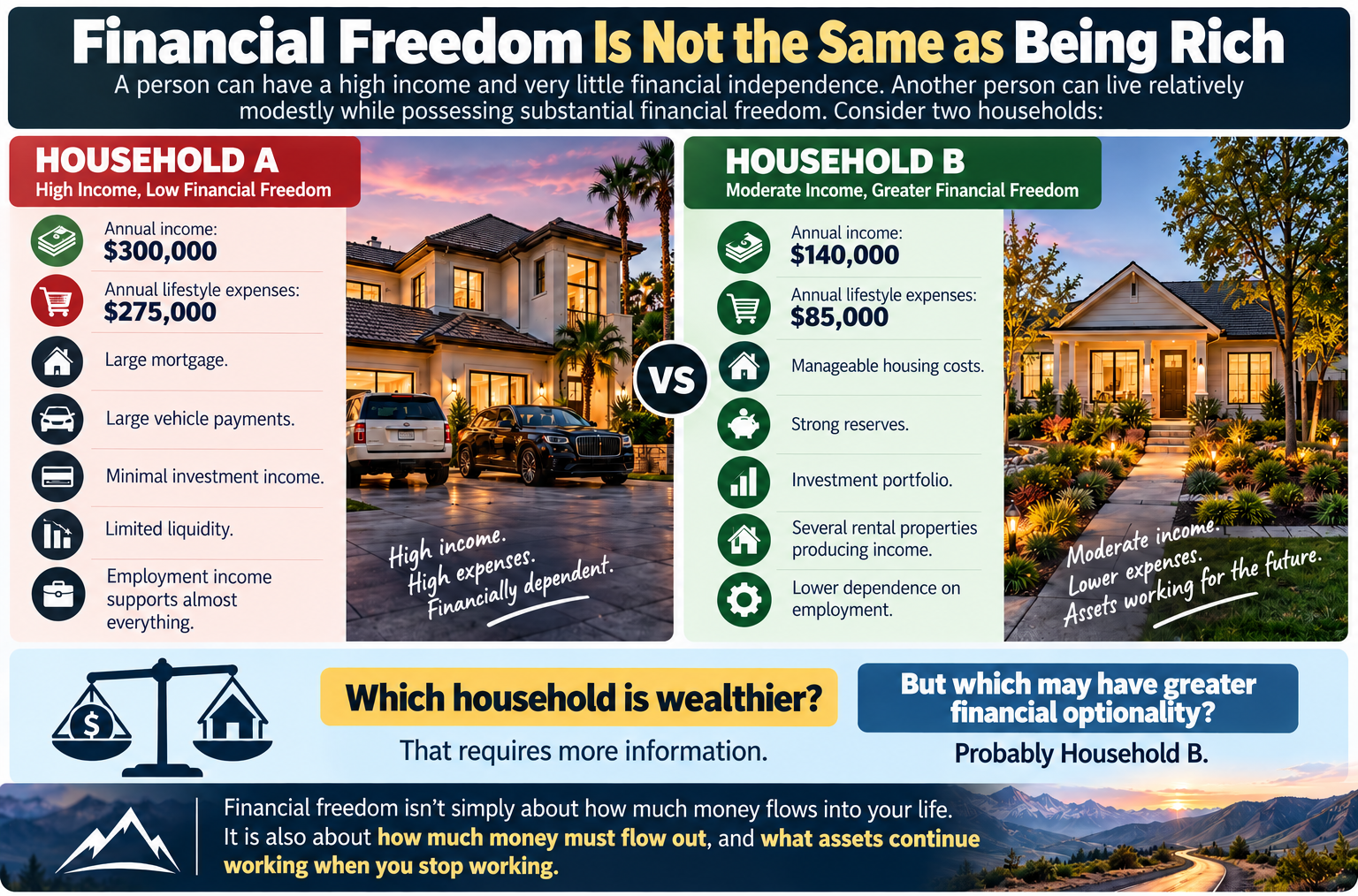
Ask ten people what financial freedom means, and you may get ten different answers. Someone earning $250,000 while spending $245,000 may have less freedom than someone earning $90,000 with low expenses, meaningful savings, manageable debt, and income-producing assets. Income matters, but the more useful questions are:
How dependent are you on your next paycheck?
What does your desired life cost?
And how much of that cost could eventually be supported without requiring your labor?
How dependent are you on your next paycheck?
If losing your income for three months would create an immediate crisis, your standard of living may be high while your financial flexibility remains low. Start defining your destination across seven dimensions: time, income, debt, security, family, lifestyle, and legacy. Together, they turn financial freedom from an abstract aspiration into a personal planning framework.
The Strategy Should Change as You Get Closer to Freedom
This is why TrueMarket treats a first home as more than an emotional decision. Your home needs to work for your life, but the property you choose can also influence your future financial position.
Consider two buyers: Both can afford a $500,000 property. One purchases at the absolute top of their budget and leaves little room to save or invest. The other purchases a property that meets their needs for $425,000 and maintains greater monthly flexibility. Neither decision is automatically correct. Perhaps the $500,000 property has materially better fundamentals. Perhaps the $425,000 property creates a better financial runway. The point is that housing decisions and wealth decisions are often connected. Your first property can either consume nearly all of your available financial capacity, or become part of a broader strategy.
Early in an investor’s journey, the priority may be acquisition. You need assets. You need equity. You need experience. You need to scale the portfolio to create value. Later, the objective may change. Perhaps you no longer need maximum growth. Now you care more about protecting cash flow, reducing debt, increasing liquidity, reducing operational complexity, retaining your strongest properties, planning for family, and reclaiming time.
Suppose your portfolio produces significant income, but you personally handle every tenant call, every repair, every showing, every bookkeeping issue, every contractor, every late payment, every turnover. You may own a business, but have you created freedom? Perhaps not yet. This is why financial freedom and operational freedom eventually need to meet. Systems matter. Property management matters. Asset quality matters. Portfolio simplicity matters. The amount of income you generate is important. The amount of your life required to maintain that income is important too.
Financial Freedom Requires Resilience
A portfolio that works only when everything goes right is fragile. Real properties experience repairs, vacancies, unexpected capital expenses, changing market conditions, financing changes, regulatory changes, and tenant turnover. Financial freedom should therefore include margin for error. That should mean adequate reserves, sustainable debt, appropriate insurance, realistic maintenance assumptions, diversified sources of income, conservative investing, liquidity outside the properties. Freedom becomes more meaningful when it can survive disruption.
Don’t Sacrifice Your Entire Present for an Imaginary Future
There is another trap. An investor can become so focused on financial independence that every present decision becomes subordinate to an imagined future date. One more property. One more renovation. One more year. One more deal. Then I’ll live. That can become its own form of dependency. The objective should not be to postpone life indefinitely. The better question is: How can each stage of wealth creation increase my freedom along the way?
Maybe your first rental doesn’t replace your salary, but perhaps it pays for your annual family vacation. The next one helps fund retirement. Another allows your spouse to work fewer hours. Eventually, the portfolio may cover the mortgage. Then the essential household expenses. Then perhaps the entire lifestyle. Freedom can arrive incrementally
If the entire purpose of building wealth is merely to accumulate more wealth, there is no natural finish line. Real estate should ultimately serve the life you’re trying to create.
Frequently Asked Questions
What is the difference between financial freedom and financial independence?
The terms are often used interchangeably. A useful distinction is that financial independence can describe the financial condition in which assets and recurring income can sustainably support your lifestyle, while financial freedom describes the broader control and optionality that condition can create.
How much money do I need to be financially free?
There is no universal amount. Your target depends on your spending, debt, desired lifestyle, investment income, liquidity, risk tolerance, and other financial resources. Start by understanding what your desired life actually costs.
Can real estate create financial freedom?
Real estate can contribute through potential cash flow, debt reduction, equity accumulation, appreciation, and value creation. None is guaranteed, and properties must be evaluated individually. Real estate is one potential tool rather than a guaranteed path to financial independence.
How many rental properties do I need for financial freedom?
There is no correct property count. Five strong properties can potentially serve an investor better than twenty poorly performing ones. Focus on net economic performance, risk, debt, reserves, management requirements, and the income your lifestyle requires.
Should I pay off my rental properties before retiring?
There is no universal answer. Lower leverage can reduce required debt service and financial risk, while leverage can preserve liquidity and capital for other investments. The appropriate decision depends on your broader portfolio, financing terms, income requirements, taxes, risk tolerance, and objectives.

Your Next Move
Define what you want your money to make possible, what that life costs, how much dependence on employment and debt you will accept, how much complexity you want to manage, and how much time your investments should require. Then determine what combination of income, assets, equity, liquidity, and real estate ownership could realistically help you get there.
Explore TrueMarketValue.net to identify investment grade rental cash flow, and fix and flip properties through Fundamental Value, Conditional Value, and the Four Real Estate Quadrants™—and start building a real estate strategy around the future you want.
TrueMarketValue.net – Find Value. Create Value. Own Value. Build Wealth.