
Most properties are not obvious bargains. They do not come with a sign that says: “This Home Is Worth More Than the Asking Price.” More often, opportunity begins with a discrepancy. Something about the property, the listing, the condition, the seller, or the surrounding market does not quite line up. The asking price may be too low. The market may be overlooking a property’s underlying fundamentals. The home may present poorly even though its location is strong. Recent comparable sales may suggest more value than the current listing reflects. Or the seller may simply value certainty and speed more than maximizing price. At TrueMarketValue.net, we believe investors and value-minded buyers should learn to recognize these inconsistencies.
Not because every unusual property is a deal.
But because unusual situations are often where additional investigation becomes worthwhile.

First, What Do We Mean by “Mispriced”?
A property may be mispriced when its asking price appears materially inconsistent with the value suggested by relevant market evidence. That sounds simple. In practice, it can be complicated. The discrepancy may result from:
Sometimes the apparent discount is real. Sometimes further investigation explains it completely. That’s why a signal is not proof. It is a reason to look more closely.
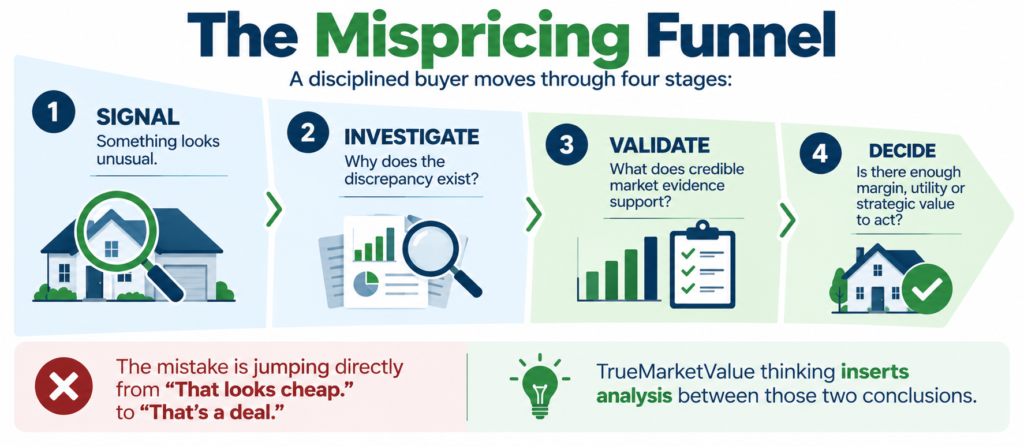

The list price is the price at which the seller has offered the property for sale. It may be supported by excellent market analysis, may be intentionally aggressive, may be deliberately low to generate competition, may reflect the seller’s expectations, or the seller’s circumstances. Occasionally, it may simply be off. The list price is information, not proof of value.
So, What Is True Market Value?
For purposes of the TrueMarketValue philosophy, think of True Market Value as an evidence-based assessment of what a property should reasonably command in the current market and in its current condition. That means asking:
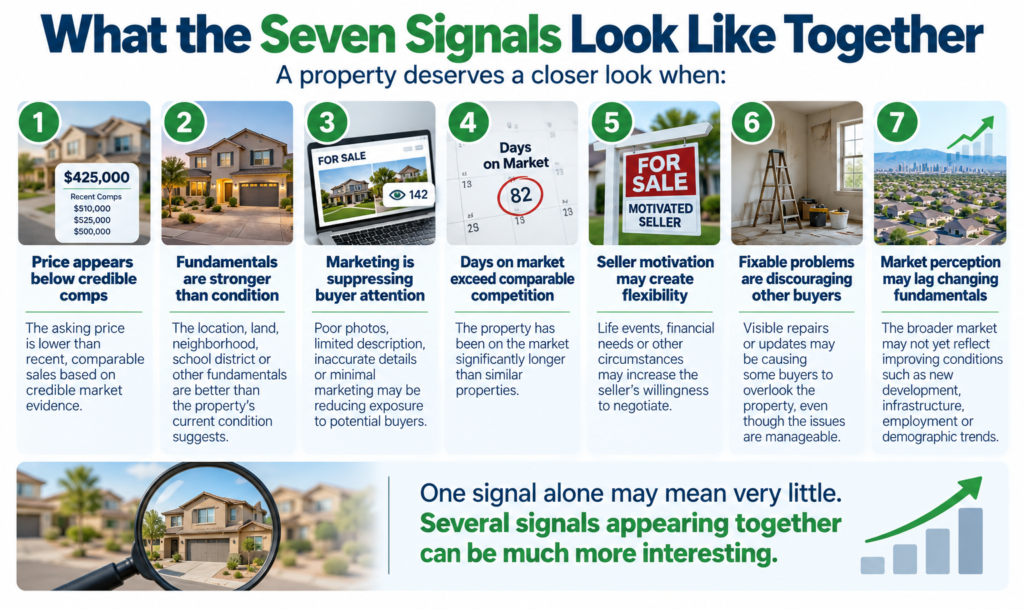
This is the most obvious signal, and one of the most important. Suppose a property is listed for $395,000, but several genuinely comparable homes have recently sold between $425,000 and $440,000. That deserves attention, but notice the key phrase: Genuinely comparable.
The sales need to make sense. A similar location. Similar property type. Comparable size. Comparable lot. Relevant condition. Recent enough to reflect current market behavior.
Potential pricing discrepancy: investigate further. What Could Explain It? Before assuming you’ve found instant equity, ask: Does the subject require substantial repairs? Are the comparable properties superior? Is there a location difference you missed? Has the market softened? Is the seller intentionally pricing low to create competition? Are there transaction complications? The signal gets you interested, but the evidence determines whether the opportunity survives scrutiny.
This is one of the most important TrueMarketValue concepts. A property may be unattractive today without being fundamentally weak. Consider a home with desirable location; good lot; established neighborhood; functional structure; but also dated paint; old flooring; worn kitchen; poor landscaping; weak presentation.
Many retail buyers respond primarily to what they can see. That can create an opportunity for someone who understands the difference between Fundamental Value and Conditional Value.
A mispriced property frequently appears in Q3 — OPPORTUNITY (Higher Fundamental Value + Lower Conditional Value). The market may be discounting what is visible today while underappreciating what cannot easily be recreated.
Real estate is sold through presentation. That creates a simple reality: Poor marketing can reduce buyer attention even when the underlying property is attractive. Look for dark or low-quality photographs; too few photos; no useful description; poor staging; cluttered interiors; confusing listing information; weak exterior presentation; incomplete property details; no floor plan where one would be valuable; inaccurate or generic marketing copy.
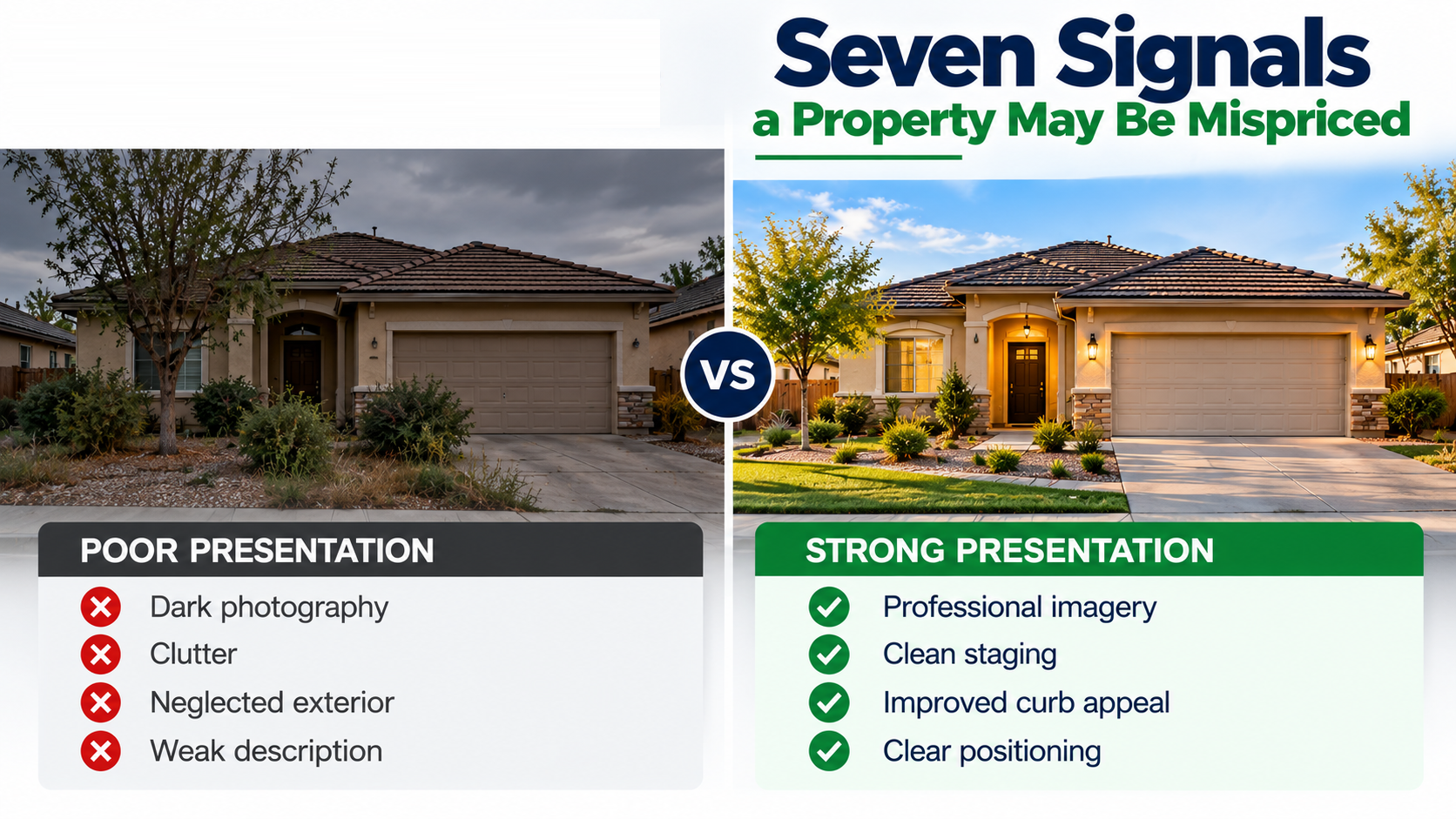
A property’s marketability and its underlying value are related, but they are not identical. When presentation is weak, buyers may overlook a property that deserves more attention. For a Q3 investor, that can be interesting.
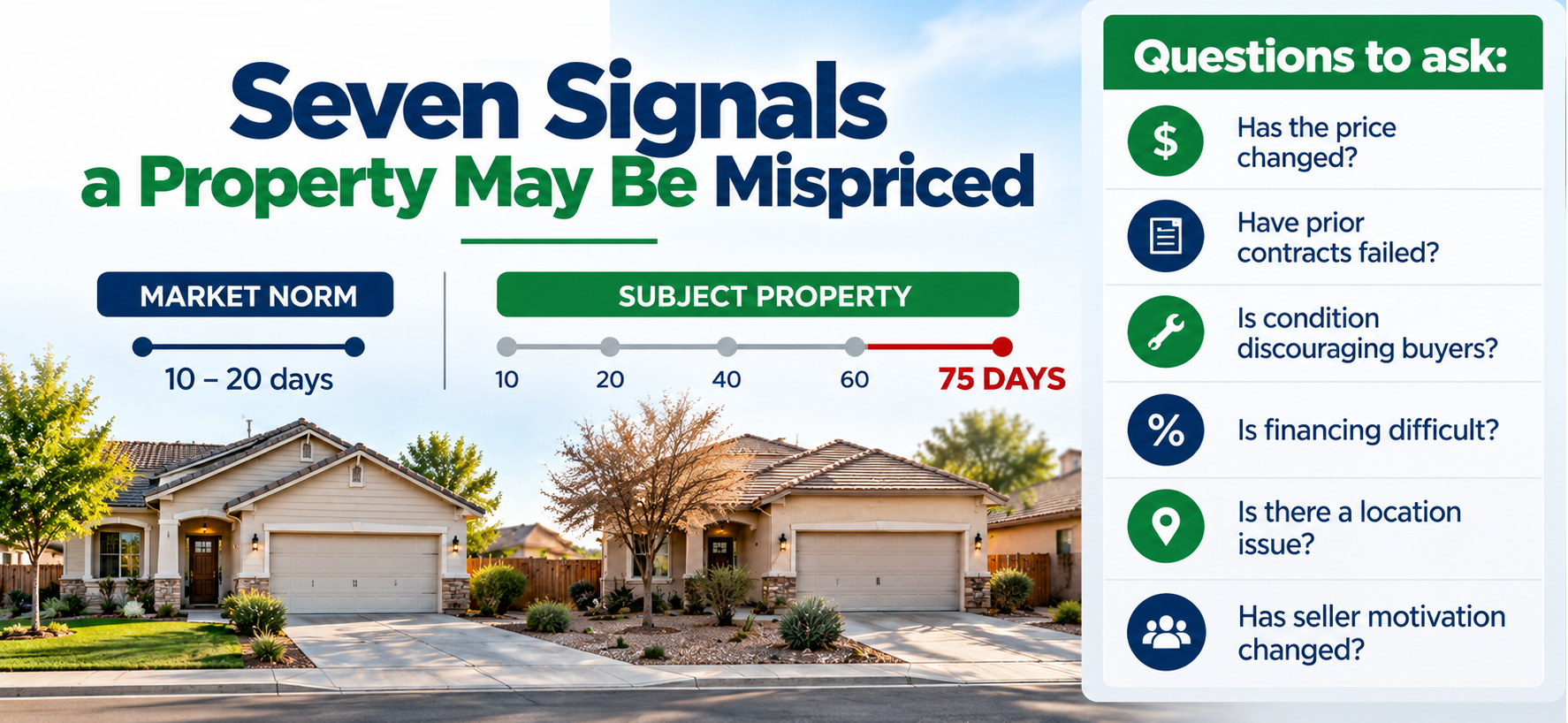
Days on market can tell you something. Not always everything. But something. Suppose comparable properties have been selling in: 10–20 days while the property you’re evaluating has been listed for: 75 days. That gap creates questions. Why hasn’t it sold? Maybe the original price was too high. Maybe earlier buyers were scared off by condition. Maybe there were financing issues. Maybe the listing fell out of contract. Maybe the market has simply overlooked it. Or maybe there is a real problem. The point is not: “Old listing = bargain.” The point is: Longer-than-normal exposure can create negotiating leverage and signal a changing seller position.
5. The Seller Appears More Motivated Than the Market Realizes
Seller motivation can create pricing flexibility. Not every seller has the same objective. One seller may want the highest possible price regardless of timing. Another may prioritize a fast closing; certainty; fewer contingencies; avoiding another mortgage payment; relocation timing; estate settlement; portfolio liquidation; simplifying a complicated situation. This does not mean exploiting sellers. It means understanding that real estate transactions involve more than a single variable. Price is one term. Certainty is another. Timing is another. Convenience is another.
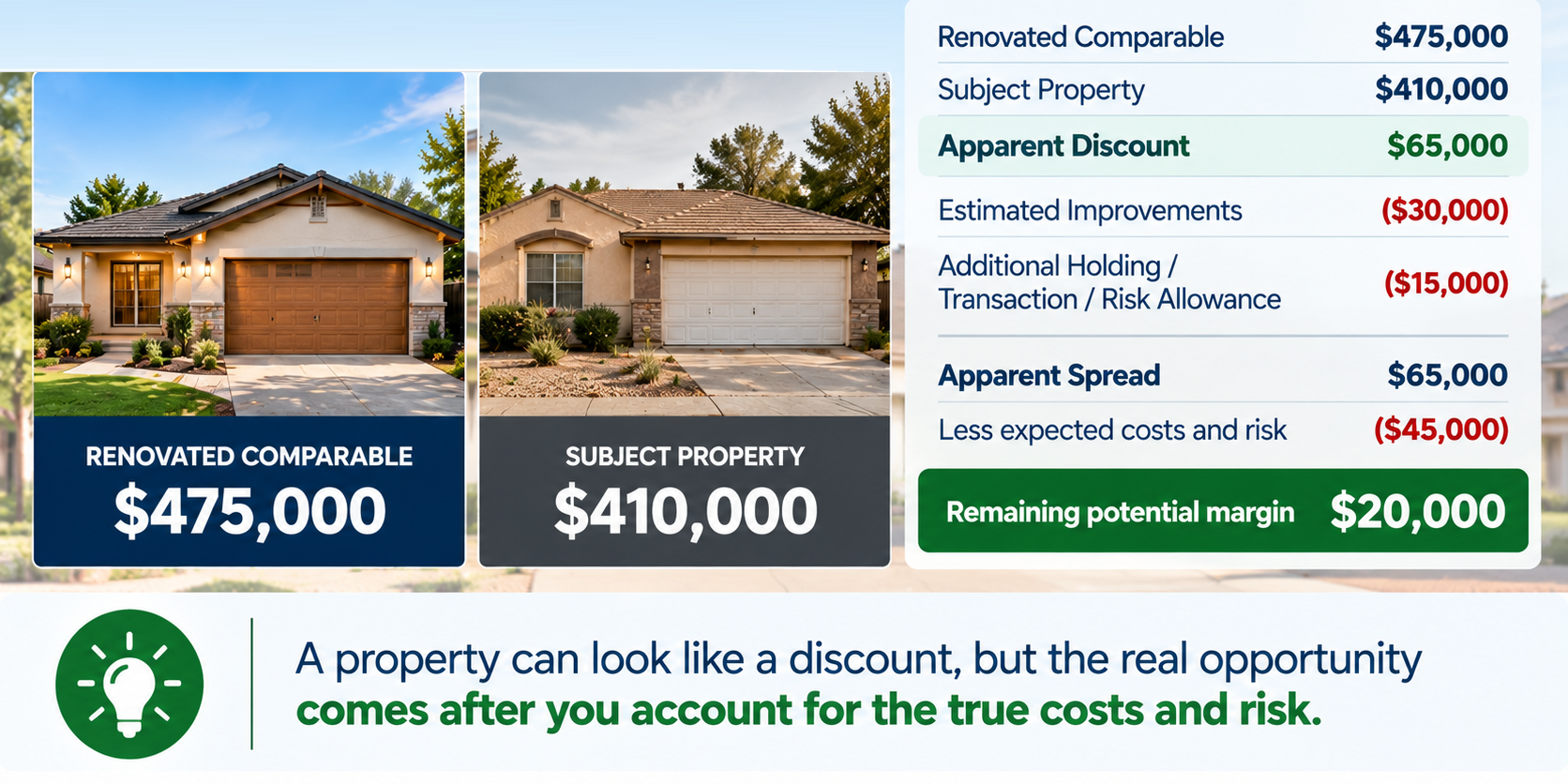
Many buyers do not want projects. They want move-in-ready. That preference creates a market premium for convenience. And sometimes a corresponding discount for inconvenience. A property requiring flooring, paint, kitchen updates, landscaping, deferred maintenance, bathroom renovations, cleanup, and minor repairs, may receive significantly less buyer attention than a renovated competitor. That doesn’t automatically make it undervalued. You need to compare: Discount Received against Cost + Risk + Time Required to Correct the Condition
Markets change. Neighborhoods change. Buyer preferences change. Infrastructure changes. Employment centers shift. New schools, retail, transportation, amenities or development can alter how buyers perceive an area. Sometimes prices adjust quickly. Sometimes the momentum lags. This can create situations where a property’s underlying fundamentals are improving faster than conventional assumptions. But this is also where buyers need discipline. Do not confuse: “Something might happen here.” with “Current evidence supports higher value.” The strongest opportunity exists when changing fundamentals are becoming visible in real transaction evidence—not just speculation.
Mispricing Can Work in Both Directions
This article focuses on identifying potentially undervalued properties. But TrueMarketValue discipline works both ways. Properties can also be overpriced. Look for the opposite signals:
The “Why Is It Cheap?” Test
Whenever you believe you’ve found a mispriced property, stop and ask: Why?
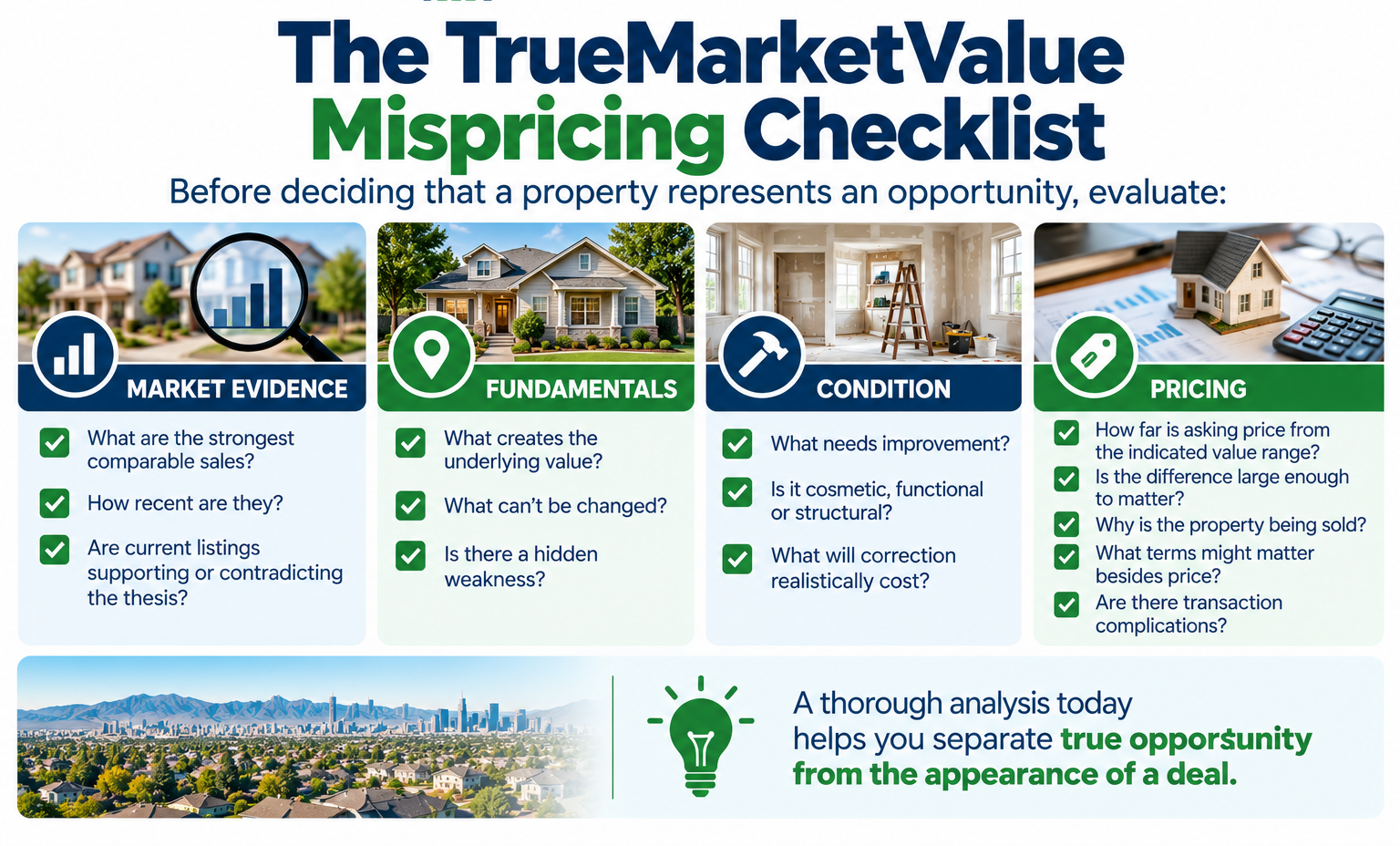
Then build the strongest possible argument against your own thesis. Maybe it needs a roof. Maybe insurance is difficult. Maybe the comparable sales aren’t truly comparable. Maybe the floor plan is functionally inferior. Maybe an external influence hurts the lot. Maybe the seller priced it low because they expect a bidding war. Maybe your renovation assumptions are too optimistic. Good investing isn’t about falling in love with your thesis. It’s about trying to break it before the market does.
Four False Signals That Can Look Like Opportunity
Opportunity requires evidence. Not optimism.
Why Q3 Opportunities Matter So Much
Within the Four Real Estate Quadrants™, Q3 occupies a particularly important position for value-oriented investors.
Q3 — Opportunity = Higher Fundamental Value + Lower Conditional Value
This is where a property can sometimes offer:
But Q3 does not mean “Fixer = good deal.” A Q3 property still has to be purchased correctly. You need sufficient margin. You need a realistic renovation plan. You need an exit strategy. And you need to understand how much Conditional Value the market is actually willing to reward.
Mispricing Is Where the Search Becomes Interesting
Real estate wealth rarely begins with perfection. Sometimes it begins with seeing something other buyers do not. A strong location behind dated finishes. A good property behind bad photographs. A motivated seller behind a stale listing. A manageable renovation behind someone else’s inconvenience. An attractive price supported by market evidence. The skill is not spotting a cheap house. The skill is recognizing the difference between a discount and an opportunity.
The TrueMarketValue Philosophy: Learn to notice the discrepancy. Then investigate it.
Understand the fundamentals. Understand the condition. Understand the seller. Understand the market. Understand the cost of fixing what is wrong. And determine whether the numbers leave enough room for your strategy to work. Because opportunity is created by the gap between price and value.
Find Value Before Everyone Else Does.
The best opportunities are not always the properties with the biggest price reductions. They’re the properties where the market may be misunderstanding something important. Your job is to find out whether that misunderstanding is real. And when it is move with a disciplined plan
Find Value. Create Value. Own Value. Build Wealth.