What About the Appraisal?
An appraisal can be an important part of a financed real estate transaction, but first-time buyers should understand an important principle:
Don’t outsource your entire purchase decision to someone else’s valuation process.
Your objective is to become informed enough to understand the relevant comparable evidence; the property’s major strengths; its important weaknesses; its current condition; its competitive position; and the price you’re willing to pay. An appraisal may become another important piece of information, but it shouldn’t be the first time you seriously ask what the property is worth.
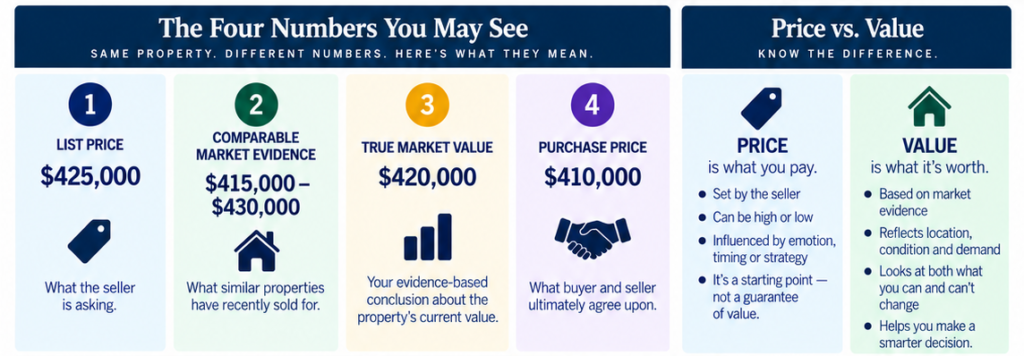
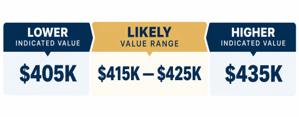
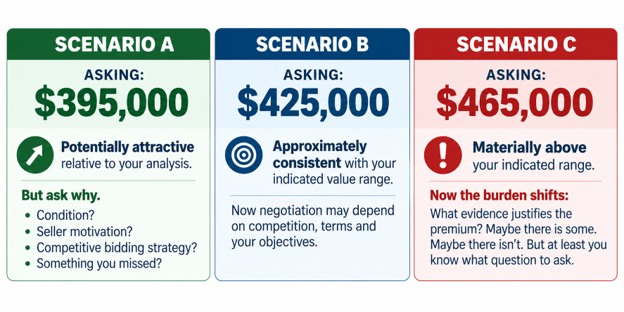
Understanding True Market Value doesn’t necessarily mean making the lowest possible offer. It means understanding the relationship between: VALUE and PRICE. Imagine your analysis indicates a likely True Market Value: $420,000–$430,000. Now consider three scenarios:
You don’t make money in real estate simply because prices go up. Your financial outcome begins with what you buy, what you pay, how you finance it, what it costs to own, and what happens afterward.
Suppose a property appears to be worth $425,000 and is available for $395,000. Wonderful? Maybe, but now ask:
- Does it require major repairs?
- Are there title or transaction complications?
- Is the location appropriate for your needs?
- Does it require more renovation capital than you possess?
- Does it fit your intended strategy?
- Are there risks that explain the discount?
A discount is an invitation to investigate, not necessarily an instruction to buy.
True Market Value Is Only Part of the Decision
A property could be attractively priced and still be the wrong purchase for you. Your decision has several layers.
- VALUE: What is the property reasonably worth?
- PRICE: What will you have to pay?
- FINANCING: What will the capital cost?
- OWNERSHIP: What will taxes, insurance, maintenance, association fees and other obligations cost?
- CONDITION: What additional capital may the property require?
- FLEXIBILITY: What could you do with the property later?
- YOUR DECISION: That is why TrueMarketValue is a framework for making decisions, not simply finding a number.
The First-Time Buyer’s True Market Value Test
Before making an offer, work through these questions.
1. MARKET EVIDENCE
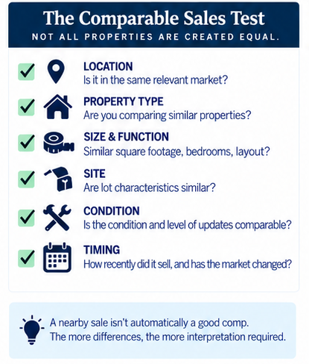
- What are the strongest comparable sales?
- How recent are they?
- Why are they genuinely comparable?
- What differences in the properties matter?
2. FUNDAMENTAL VALUE
- What characteristics can’t I easily change?
- What makes this location and site desirable, or undesirable?
- Are those fundamentals consistent with my objectives?
3. CONDITIONAL VALUE
- What condition is the property currently in?
- What has already been improved?
- What still needs attention?
- Am I paying an appropriate premium for those improvements?
4. PRICE
- What is the asking price?
- What does the evidence suggest?
- What am I willing to pay?
- Why?
5. TOTAL OWNERSHIP COST
- Mortgage payment?
- Property taxes?
- Insurance?
- Association fees?
- Maintenance?
- Near-term capital improvements?
6. FLEXIBILITY
- Could I improve it?
- Could I reasonably resell it?
- Could I potentially rent it?
- Could it meet my needs longer than expected?
And most importantly: Does the property fit what I’m trying to accomplish?
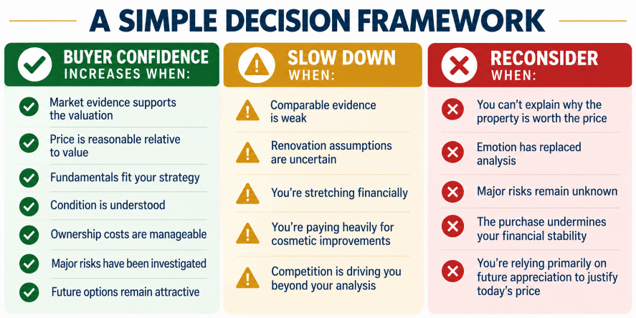
You can’t know everything about real estate, and you won’t eliminate uncertainty. The objective is simply: Become an informed buyer. Learn to ask better questions. Learn to challenge assumptions. Learn to distinguish appearance from fundamentals. Learn to examine comparable evidence. Learn to understand price in relation to value. And learn to recognize when you don’t yet have enough information to make the decision. That’s a valuable skill whether you’re purchasing your first home; your first fixer; your first rental; or eventually, your tenth investment property.
You’re Learning How to See Real Estate Differently
Your first purchase teaches you how real estate works. How markets establish prices. How condition affects desirability. How financing changes affordability. How renovations create, or destroy, economic value. How neighborhoods differ. How buyers behave. And eventually, how property can become part of a larger financial strategy. You don’t have to become a real estate investor, but you can learn to think like one when the decision matters. The goal isn’t to find the cheapest house. It isn’t to win every negotiation. And it isn’t to perfectly predict what a property will be worth ten years from now. The goal is to make a major financial decision with your eyes open. Know what you’re buying. Know why you’re buying it. Understand what the evidence says, and don’t confuse price with value. Because the American Dream isn’t simply buying a home. It’s buying it right.
Find Value. Create Value. Own Value. Build Wealth.